Dear French Bulldog owners, hello everyone. It is delightful to see your beloved French Bulldogs running and rolling joyfully on sandy beaches. Yet during clinical consultations, I frequently encounter French Bulldogs suffering red, itchy and even infected skin due to improper post‑beach cleaning. Such cases surge in spring and summer. Drawing on over ten‑years of front‑line experience in pet clinical work and animal care, I would like to talk through this topic — how to give your French Bulldog a thorough post‑beach cleanup, remove irritating fine sand and protect their delicate skin.
Why French Bulldogs Require Extra‑Careful Cleaning After Beach Visits
First we need to understand the core issue. French Bulldogs are well‑known for sensitive skin, largely caused by their unique physiology. Firstly, they have abundant skin folds around the face, neck and tail base. These cute creases act like tiny pockets where fine sand, seawater and sweat easily accumulate, forming warm damp conditions ideal for bacterial and fungal growth. Secondly, their short dense fur lets sand grains lie closely against the skin, which cannot be fully removed by towel‑wiping alone. Thirdly, their erect ears have narrow openings; sand and seawater may flow inside during play and trigger otitis externa without timely cleaning. Fourthly, deep gaps between paw pads trap fine sand. Constant friction while walking may lead to pad abrasions or interdigital dermatitis. With this understanding, you can carry out targeted cleaning.
Practical Experience: Five‑Step Complete Cleaning Routine to Eliminate Trapped Sand
These steps are summarised from real‑world practice. I have treated many cases caused by skipping any single step. Please work patiently and thoroughly.
Step 1: Immediate Rough‑Processing Right After Leaving Water
Never let your sand‑covered French Bulldog jump straight into the car or go home. Prepare a large collapsible bucket and plenty of clean fresh tap water; avoid cold seawater. Find a suitable rinsing spot near the beach.
Field tip: One owner once decided to delay bathing until home because the dog looked tired. During the 30‑minute car ride, salt and sand irritated the dog so severely that it kept rubbing against car seats. By arrival, skin under armpits and groin was already raw and red. Therefore, rinse off most surface salt and loose sand with abundant fresh water as soon as possible. Gently massage the coat, focusing on back, belly and limbs to wash away clumps of sand. Keep water pressure gentle so you do not frighten your dog.
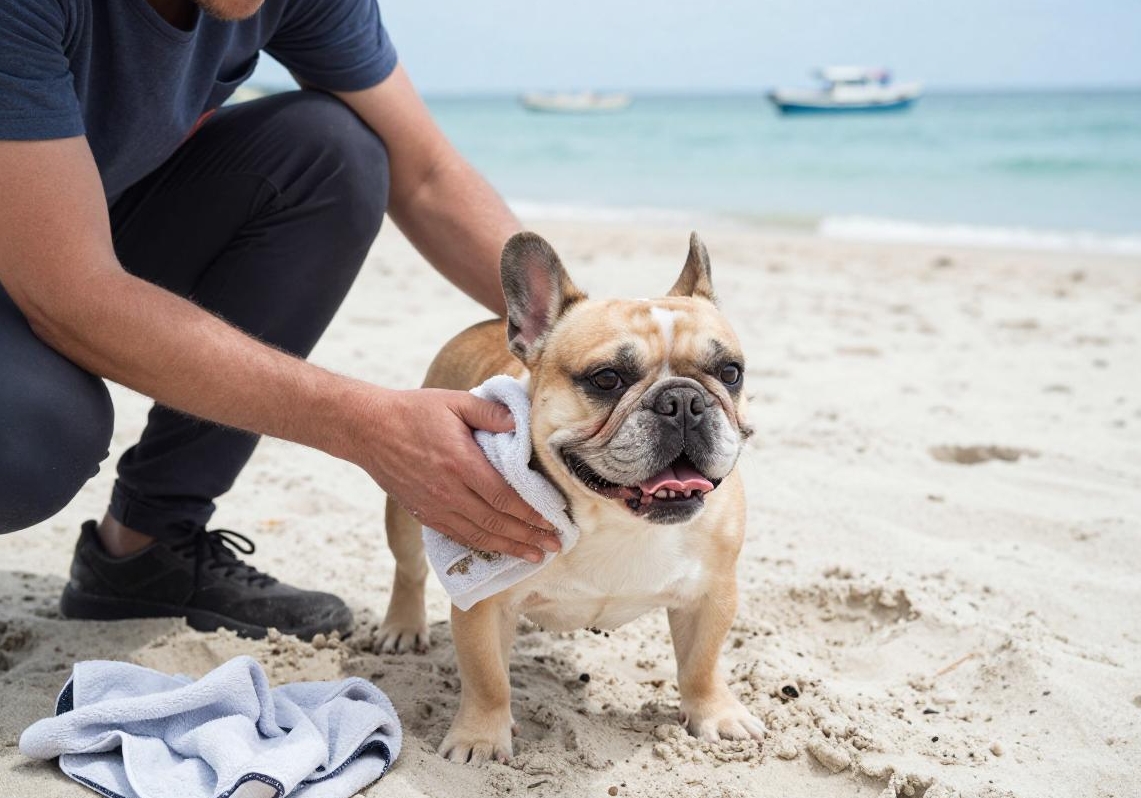
Step 2: In‑Depth Home Bath — Focus on Fold Zones
Give a proper full bath immediately after arriving home. Use mild pet‑specific shampoo; hypo‑allergenic or oatmeal formulas are preferred.
Critical procedure: Gently pull open every skin fold with fingertips so water and lather penetrate fully inside each crease. Pay special attention to folds on face, neck and tail base. Use your fingertips to cleanse facial folds as if washing a human face, using extremely gentle movements. Rinse comprehensively to eliminate all shampoo residue and trapped sand; leftover shampoo itself irritates skin. Rinse repeatedly until draining water runs completely clear.
Step 3: Delicate Ear‑Canal and Paw Care
This stage is most often overlooked and frequently causes health complications.
Ear cleaning: Apply pet‑formulated ear cleaner. Instill liquid into the ear canal — do not insert the dropper too deep. Gently massage the outside base of the ear until you hear squelching sounds. Release and let your dog shake its head naturally to expel deep‑seated fluid and debris. Wrap cotton balls or soft tissue around your finger to wipe only visible outer ear surfaces. Never push cotton swabs deep into ear canals; this may drive sand further inward or damage ear tissue.
Paw cleaning: Fill a shallow basin with warm water. Submerge paws, gently separate each toe, massage pads and interdigital gaps to dislodge embedded sand. Upon finishing, absorb all moisture using absorbent towels; keep toe gaps fully dry. I once treated a severe interdigital dermatitis case caused by undetected sand trapped long‑term between toes leading to recurring infection.
Step 4: Maximum‑Absorption Towel Drying + Full Blow‑Drying
French Bulldog skin hates dampness; drying matters even more than bathing itself. Wrap the whole body with super‑absorbent towels and press firmly to soak up excess water. Operate your hair‑dryer on medium‑low heat and airflow, starting from the back. While blowing, separate fur with your hands or a pin brush to ensure airflow reaches skin level.
Lesson learned: Early in my career I thought dry‑looking surface fur was sufficient. One patient developed Malassezia dermatitis because folds in armpits and groin stayed damp underneath. Always pull every fold apart and dry underlying skin until it feels fully dry and warm by touch. This procedure takes patience and normally lasts 20‑30 minutes.
Step 5: Final Inspection & Positive Reinforcement After Drying
Do not finish right after blow‑drying. Place your French Bulldog under bright lighting. Run your hands over its entire body again. Check whether skin feels smooth and no gritty sand remains. Inspect for redness, papules or broken skin. Conclude with affection and treat rewards so your dog associates cleaning with pleasant experiences.
Pitfall‑Avoidance Guide: Do Not Make These Common Mistakes
1. Rely only on damp towel wiping: This cannot remove sand hidden inside folds or at fur roots, and ranks among top causes of skin complaints.
2. Use human shampoo or soap: Human skin pH differs from canine skin. Human‑grade products destroy French Bulldogs’ fragile protective lipid layer and trigger dryness and itching.
3. Ignore ears and toe gaps: These hidden spots are where most skin problems originate.
4. Incomplete drying: “Almost dry” conditions breed skin diseases. Skin must be 100 % dry.
5. Long delay before cleaning: The longer sand and salt sit against skin, the stronger the irritation.
Summary
Beach outings create wonderful bonding moments for you and your French Bulldog. Preserving that joy requires careful post‑play care. Remember prevention beats cure. A complete, patient cleaning routine brings immediate comfort and saves your dog from weeks or longer of skin trouble. Treat cleaning as part of beach fun, and both you and your French Bulldog will enjoy every seaside trip more fully.
Important Reminder
Monitor your dog’s skin closely for several days after cleaning. Seek veterinary attention if you notice frequent scratching at one spot, persistent red patches, rashes, pustules, hair loss, or smelly ears with heavy discharge and repeated head‑shaking. These may signal infection or allergic reactions. Do not self‑medicate; treatments for fungal, bacterial and allergic conditions differ greatly. Immediately halt all skin‑irritating activities and visit a professional animal hospital for formal diagnosis and treatment. Early intervention resolves problems faster and with less discomfort for your pet.